
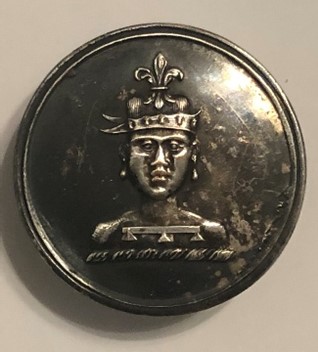
blackamoor wearing fleur-de-lis crown
Description
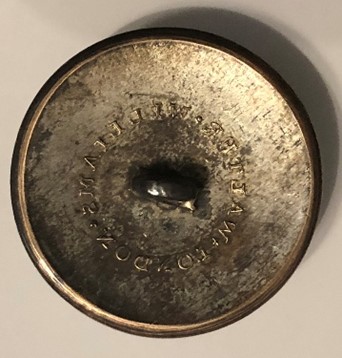
Size 1 1/8th one piece silvered brass. Manufactured by Walter Williams, St Martins Lane, London.
Cadency 1st son or heir; see symbol above the Torse.
Williams backmark is often found on top quality, late 18th and early 19th century livery and uniform buttons.
Background/Story
This button’s back mark suggests that it was made between 1815-1824 according to Tom Skovronsky’s Livery Buttons: Identification, Classification and Heraldry Vol. 2.
The 1905 edition of the Fairbairn’s book of crests of the families of Great Britain and Ireland has a description:
a blackamoor’s head affrontee, couped at the shoulders ppr., in the ears earrings or, and on his head a chapeau gu., turned up erm., charged with a crescent, issuing thereform a fleur-de-lis or.
Quiz: Is this a perfect match? Let’s parse it out!
Log in to see the answer in the comment area.
- “A blackamoor’s head affrontee, couped at the shoulders ppr.”
- “Blackamoor’s head”: A representation of a black man’s head.
- “Affrontee”: The head is facing forward (full frontal view).
- “Couped at the shoulders”: The head is cleanly cut off at the shoulders.
- “Ppr.” (Proper): a black person in his natural form, rather than stylized or tinctured.
- “In the ears, earrings or”
- “Earrings or”: The figure is wearing gold earrings in both ears.
- “And on his head a chapeau gu., turned up erm.”
- “Chapeau gu.”: A red (gules) cap.
- “Turned up erm.”: The rim (or turned-up part) of the cap is made of ermine fur (a white fur with black tail spots, symbolizing nobility).
- “Charged with a crescent, issuing therefrom a fleur-de-lis or.”
- “Charged with”: A design is placed on the cap.
- “A crescent”: A gold crescent (a half-moon shape) appears on the cap.
- “Issuing therefrom a fleur-de-lis or”: From the crescent emerges a gold fleur-de-lis (a stylized lily symbol often associated with French heraldry).
Note also the label above the torse (the twisted fabric between the helm and the crest) to indicate cadency.
- This suggests that the bearer is the eldest son of the family while the father is still living.
- If the father dies, the son inherits the full arms and the label is removed.