
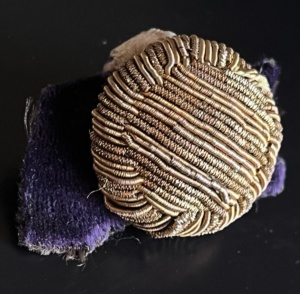
’26-05: Pretty Purl
Old clothing accessories are tangible remnants of a forgotten era. They remind us that people once dressed differently, fastened their garments differently, expressing personal taste through small objects.
Monthly digital newsletter of the Western Regional Button Association.
Old clothing accessories are tangible remnants of a forgotten era. They remind us that people once dressed differently, fastened their garments differently, expressing personal taste through small objects.

Old clothing accessories are tangible remnants of a forgotten era. They remind us that people once dressed differently, fastened their garments differently, expressing personal taste through small objects.
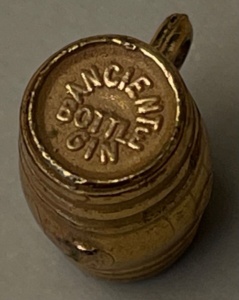
It’s a barrel, not a bottle — yet it proclaims “ANCIENT BOTTLE GIN.” Gin does not age in barrels, so why say ancient? Why put gin in a barrel?
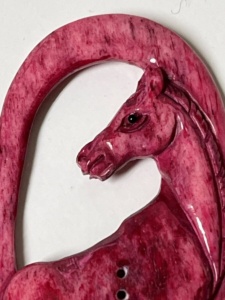
The button above is extra-large at 3¼” tall, retaining the natural curve of a bovine shin bone. Visit this button in the Button Album to view the details and watch a video of buttons being made from bones.
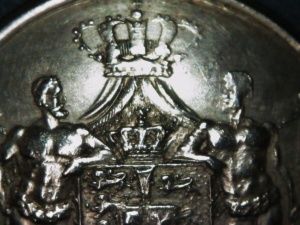
Under magnification it turns into a miniature stage set: two “wild men” supporters flank the shield, a draped pavilion frames the scene, and a royal crown with orb-and-cross sits above like a finial. The shield itself is the real marvel—nested like Russian dolls…
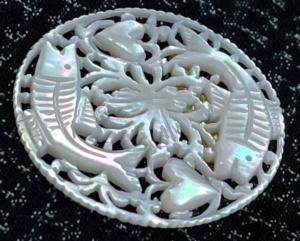
Some organizations use “DEI” to aspire for diversity, equity, and inclusion—but how? In small moments when we widen our circle and let curiosity lead, the world of “DEI” opens.
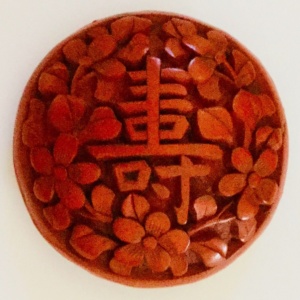
This bright red button is a carved lacquer colored with powdered cinnabar (mercury sulfide). Because cinnabar contains some levels of toxic mercury, antique pieces should be handled with care, while modern examples are often made from safer synthetic materials. Either way, the vivid red symbolizes the privilege and status in Chinese culture.
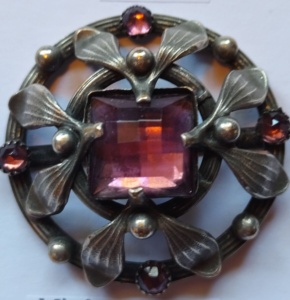
The Gilded Age (1870-1900) was a time of fabulous ambitions, when success meant not only wealth but being seen as wealthy. This month’s featured piece is more than a button — it is a declaration of refined taste, a claim in the swirl of upward mobility. Large, bejewelled buttons of 1 1/4” or more from this era are known among collectors as ‘Gay Nineties’, capturing the spirit of the age.
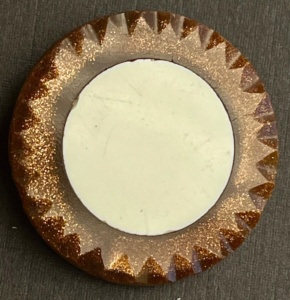
Old Venetian glass artisans recorded the method of suspending copper crystals as colloid in glass to create a glowing effect unlike anything else. Goldstone’s “magic sparkle” is not just reflection, but a combination of colloidal …
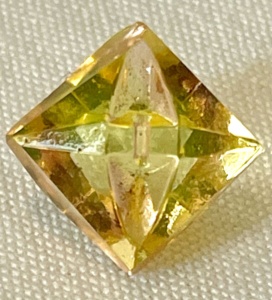
At first glance, collectors might pass it by—one of many mid-century molded glass styles once pinned to retail cards marked “Made in West Germany.” But a closer look reveals a button with hidden depth.