
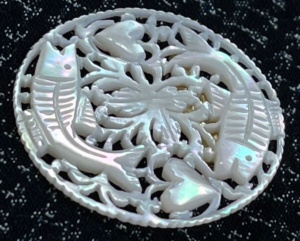
’25-12: Reaching Out
Some organizations use “DEI” to aspire for diversity, equity, and inclusion—but how? In small moments when we widen our circle and let curiosity lead, the world of “DEI” opens.
Monthly digital newsletter of the Western Regional Button Association.
Some organizations use “DEI” to aspire for diversity, equity, and inclusion—but how? In small moments when we widen our circle and let curiosity lead, the world of “DEI” opens.
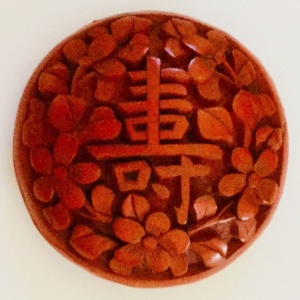
This bright red button is a carved lacquer colored with powdered cinnabar (mercury sulfide). Because cinnabar contains some levels of toxic mercury, antique pieces should be handled with care, while modern examples are often made from safer synthetic materials. Either way, the vivid red symbolizes the privilege and status in Chinese culture.
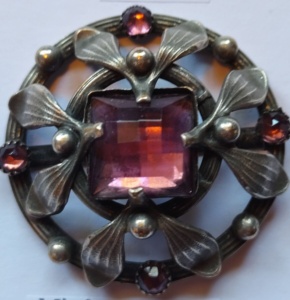
The Gilded Age (1870-1900) was a time of fabulous ambitions, when success meant not only wealth but being seen as wealthy. This month’s featured piece is more than a button — it is a declaration of refined taste, a claim in the swirl of upward mobility. Large, bejewelled buttons of 1 1/4” or more from this era are known among collectors as ‘Gay Nineties’, capturing the spirit of the age.
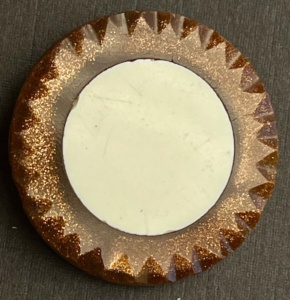
Old Venetian glass artisans recorded the method of suspending copper crystals as colloid in glass to create a glowing effect unlike anything else. Goldstone’s “magic sparkle” is not just reflection, but a combination of colloidal …
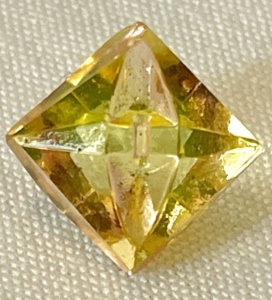
At first glance, collectors might pass it by—one of many mid-century molded glass styles once pinned to retail cards marked “Made in West Germany.” But a closer look reveals a button with hidden depth.

Satsuma refers to the historic region in southern Japan—now known as Kagoshima—once ruled by a powerful line of feudal lords. For button collectors, hand-painted Satsuma buttons originating from the actual land of Satsuma are exceptionally rare. Most vintage “Satsuma” buttons known today were produced in other parts of Japan, especially around Kyoto, and many modern examples sold online are decorated using digital ceramic printing, not traditional hand-painting.

Many buttons have backmarks that display the maker and from that, one might be able to trace the button back to where and when it was made. Silver buttons are different in that the metal itself has value and they most often carry hallmarks which reveal the purity of the metal, where and when it was made and the maker.

What began in the spring of 2023 has grown into a true community project—our Visual Bethlehem Peal pages. Built with the heart and hands of many collectors, our project […]

For many of us, the daisy has always been a simple, sweet flower — white petals, yellow center, tucked into childhood memories and garden borders. It’s easy to think we know it inside and out. But just like us, daisies have more to them than meets the eye.

A 1974 state show program album sparked our interest in our collective past. So, WSBS’s historian was asked one day to climb into her attic to dig into the society’s pile of papers.