


Background/Story
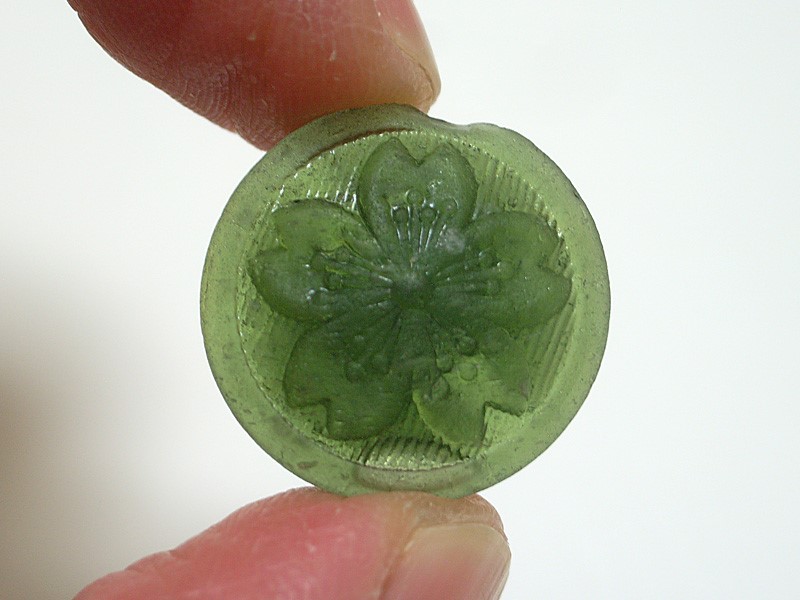
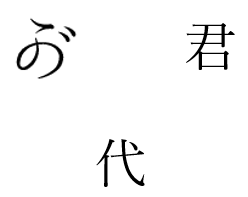
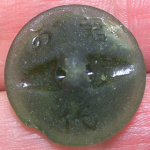
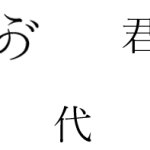
This button was first discovered by a WRBA member in Japan, on a beach comber’s blog. The button is back marked 君が代 (Kimi Ga Yo).
Kimi Ga Yo is the national anthem of Japan🎵. Its lyrics came from a poem celebrating longevity found in the 古今和歌集, a 12th Century CE anthology of poems.
君が代
(Our Majesty’s Era)
translated by mika, 2023
Your Majesty’s Time
for thousands,
and thousands
of generations —
as small pebbles become
Rock Majestic —
and on grows moss.
Kimi is a pronoun, one of many ways to refer to “you” in the Japanese language. It is still being used today, mostly in informal speeches. Ga is a connecting particle. Yo means “era, epoch, or generation”.
 古今和歌集序, Kokin Wakashū-jō, public domain
During World War II, the Japanese Empire ordered that schoolchildren, both from its homeland and its colonies, were to sing the “Kimigayo” anthem and salute Emperor Hirohito every morning. – Wikipedia: Kimigayo
The Cherry blossom design is commonly found on Japanese school uniform buttons. the origin of this glass button or the school for which it was made. The area sustained bombing during World War II.

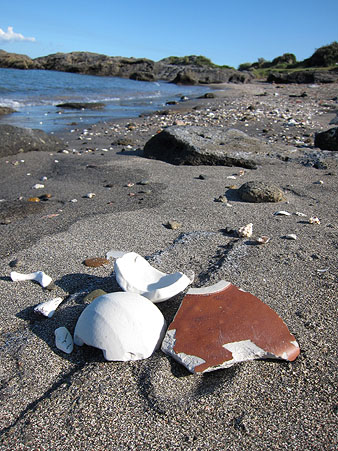
The button was discovered washed ashore in 2008 on the western side of the Miura Peninsula, opposite Tokyo and the Yokosuka US Naval base. Additionally, pieces of Ceramic hand grenades and ceramic land mines were found.
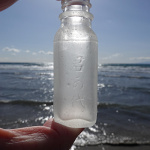
The beachcomber also discovered a glass bottle curiously bearing the same Kimi Ga Yo as the brand name, embossed on it. The bottle was for grey hair dye. This particular Kimi, meaning “you” could be interpreted as a pronoun for a young woman being courted by her admirer. Therefore, 君が代 as a grey hair treatment takes on a whole new angle, with the same sense and meaning of the words intact – Your Time in Life.
Button photos back marked 君が代 (Kimi Ga Yo), courtesy of Nao (尚) at 拾い物 (found in nature)
3-letter back mark, reading counter-clockwise from the top right, in the traditional right-to-left vertical script style.
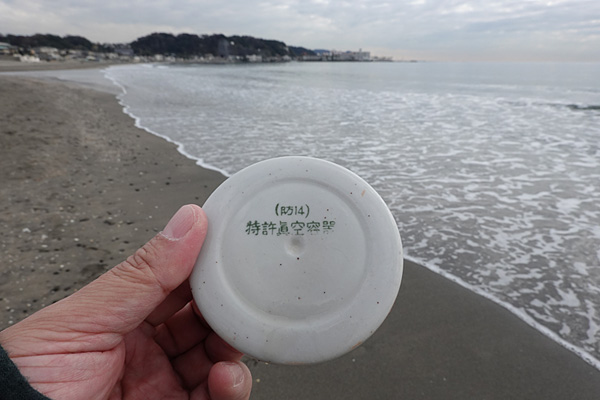
Also found washed ashore was a WWII ceramic food container lid, stamped 特許真空容器 (Patented Vacuum Container) discovered in the winter of 2022. Ceramic food preservation containers were produced during World War II to replace more common steel and tin food cans due to Japan’s nationwide mandatory metal scrap drive. The metal shortage was acute, as was the food shortage, which largely nullified the necessity for such ceramic containers.
The title “He Shall Reign” echoes in Handel’s Hallelujah chorus — and he shall reign forever and ever, though different place, different time.
 Kimi Ga Yo acapella chorus performed by the Swidish singers at the Ladies Medal Ceremony, 2008 World Figure Skating Championships, Göteborg, Sweden.
See the other, black glass button washed ashore on WRBA.