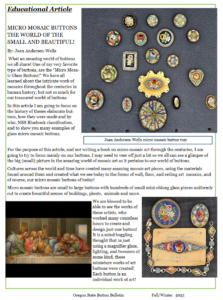
THE WORLD OF THE SMALL AND BEAUTIFUL!
by Joan Andersen-Wells
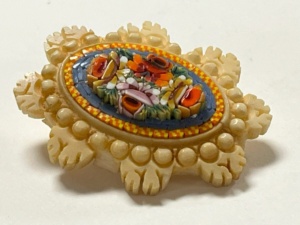
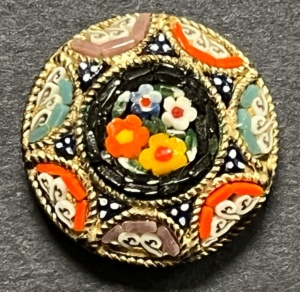
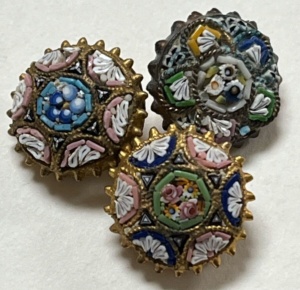
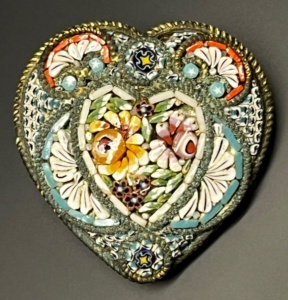
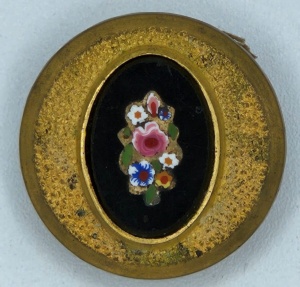
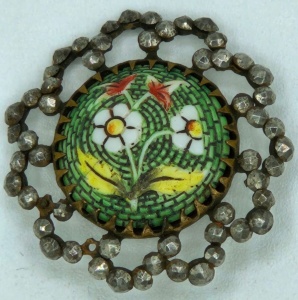
What an amazing world of buttons we all share! One of my very favorite type of buttons are the “Micromosaic Glass Buttons.” We have all learned about the intricate work of mosaics throughout the centuries in human history, but not so much for our treasured world of buttons.
In this article I am going to focus on the history of these elaborate buttons, how they were made and by whom, and NBS Bluebook classification. (editor's note: View all buttons currently tagged as 23-7 Inlay on WRBA.us. Refer also to the beautiful threadback and the cut-steel border faux mosaic buttons.)
IN SUMMARY
THE CHARACTERISTICS OF MICROMOSAIC BUTTONS ARE:
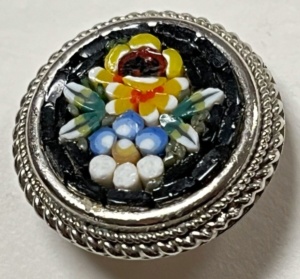
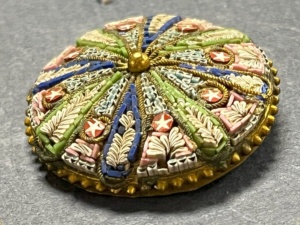
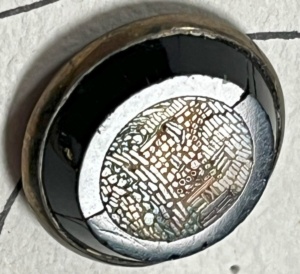
- Size: Micromosaics are typically small to large buttons, with individual pieces of glass measuring only a few millimeters in size. The most intricate micromosaics can feature up to 5,000 tesserae per square inch in the larger art pieces.
- Materials: Micromosaics are usually made from tiny pieces of colored glass, tesserae, which are arranged to form a larger image or pattern. The glass pieces may be backed with gold or silver foil to enhance their color and reflectivity.
- Technique: The glass tesserae pieces used in micromosaics are typically cut into small irregular shapes and then arranged into a larger pattern or image with tweezers and a lighted magnifier glass. The glass is then set into a cement-like material to hold it in place.
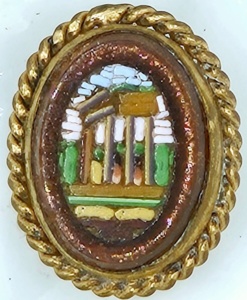
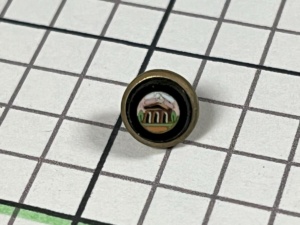
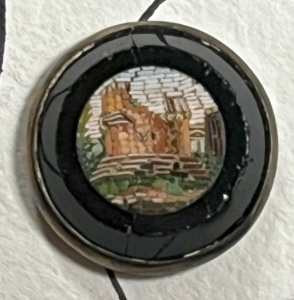
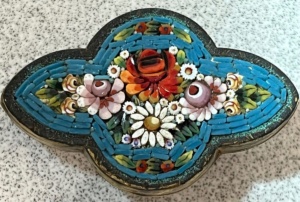
- Subject matter: Micromosaics often depict flowers, birds/animals, insects, people, landscapes, buildings as well as historical or mythological scenes.
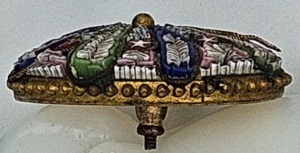
- Shapes: Round, oblong, oval, rectangular, square Back mark: Some of mosaic buttons have the back mark of “Italy,” while others have no back mark.
- Durability: Micromosaic buttons are generally very durable, but still must be handled carefully. Pieces of tesserae are sometimes MIA, as they have fallen out and lost, which is sad. This can affect the value of the button. Value: Micromosaic buttons are highly valued by us buttons collectors for their intricate beauty, subject matter, ornateness, and historical significance. Value can be in the $20.00 range to $1000.00’s of dollars, depending on their rarity, artist and subject matter.
- FAMOUS MICROMOSAICS ART YOU SHOULD KNOW:
- Doves of Pliny: In the 2nd century BCE, Sosus of Pergamon, the only mosaic artist whose name was documented in literature, created a micromosaic of doves drinking from a bowl for Hadrian’s villa. Sosus’ motif has continued to inspire artists throughout the millennia.
- The Dream of Karpa Koï bracelet: Roman mosaic and jewelry artist Maurizio Fioravanti creates fewer than ten jewelry pieces a year, with items starting at a minimum of $50,000. This bracelet renders a famous Chinese myth with the micromosaic jewelry techniques mastered by Italian artisans centuries before Fioravanti’s birth.
- Mosaic of Leonardo da Vinci's masterpiece The Last Supper: A monumental commission by Napoleon I, this historic micromosaic was created by Italian mosaicist Giacomo Raffaelli. It is a brilliant tribute to Leonardo's famed masterpiece.
- Cavalier King Charles Spaniel Micro mosaic Brooch. Circa 1850. M.S. Rau. Cavalier King Charles Spaniel Micro mosaic Brooch | M.S. Rau (rauantiques.com)
I have really enjoyed writing this article about micromosaic buttons! They are just stunning little works of art history, that someone has spent hours designing, collecting and processing the glass pieces for color and size, gathering the metal in which the tesserae is set into, glue/plaster to hold pieces in place, magnifying light, staff, getting the pieces to market and the list goes on and on! I hope you all enjoyed learning a bit about the process of micromosaic buttons; I know I have!
SOURCES:
• A Return to the Grand Tour: Micromosaic Jewels from the Collection of Elizabeth Locke - Exhibitions (vmfa.museum)
• Byzantine Art: Characteristics, History. Www.visual-arts-cork.com. November 2016.
• Department of Islamic Art. “Vegetal Patterns in Islamic Art.” In Heilbrunn Timeline of Art History. New York: The Metropolitan Museum of Art
• Dowson, Thomas. "Going Underground at the Baths of Caracalla - Archaeology Travel." Archaeology Travel. (November 2012).
• Gabriel, Jeanette Hanisee, and Angelo Gabriel. Micromosaics: Private Collections. Brian McCarthy, 2016.
• Pietre Dure and the Art of Florentine Inlay by Anna Maria Giusti (2006-05-03)
• Pietre Dire: History & Characteristics | M.S. Rau (rauantiques.com)
• Micromosaics: The Gilbert Collection by Jeanette Hanisee Gabriel
• Micromosaics Private Collections by Jeanette Hanisee Gabriel (2016, Hardcover)
• Micromosaics, Italian Smalti, Stone and Gold, di Mosaico Mosaic Art School – Ravenna, Italy
• Creating Master Works from Tiny Pieces of Glass - The New York Times (nytimes.com)
• Maurizio Fioravanti is a celebrated figure in the rarefied world of micromosaics.
• How to Visit the Vatican’s Mosaic Studio – AFAR
• Detail of micromosaic portrait of Empress Elizabeth Petrovna. Created 1750
• Detail of the Da Vinci's The Last Supper by Giacomo Raffaelli. Source.
• All you need to know about the history of micromosaic | The Jewelry Editor
• Micromosaic Snuff Box. 19th Century. M.S. Rau. Learn more about antique snuff boxes.
• The Big Book Of Buttons, Elizabeth Hughs, Marion Lester
• National Button Society’s 2023 Blue Book
The above is an updated version of the original article by Joan Andersen-Wells published in the Winter 2023 issue of the Oregon Button Society.